Σελίδα 1 από 1

Ύψος υπό συνθήκη

Δημοσιεύτηκε: Δευ Μαρ 13, 2017 1:30 pm
από george visvikis
Έστω G το βαρύκεντρο, I το έγκεντρο και AD=h το ύψος τριγώνου ABC.

α) Αν \displaystyle{a=\frac{b+c}{3}} να δείξετε ότι h=12GI και \displaystyle{GI \bot BC}.

β) Αν \displaystyle{GI \bot BC} είναι πάντα \displaystyle{a=\frac{b+c}{3}};

Re: Ύψος υπό συνθήκη

Δημοσιεύτηκε: Τρί Μαρ 14, 2017 12:06 am
από ΣΤΑΘΗΣ ΚΟΥΤΡΑΣ
george visvikis έγραψε:Έστω G το βαρύκεντρο, I το έγκεντρο και AD=h το ύψος τριγώνου ABC. α) Αν \displaystyle{a=\frac{b+c}{3}} να δείξετε ότι h=12GI και \displaystyle{GI \bot BC}. β) Αν \displaystyle{GI \bot BC} είναι πάντα \displaystyle{a=\frac{b+c}{3}};
.

1η Λύση
Υψος υπό συνθήκες.png
Υψος υπό συνθήκες.png (40.43 KiB) Προβλήθηκε 941 φορές
\bullet α) Από την τριγωνική ανισότητα ισχύει: \left\{ \begin{gathered} 
  b + a > c \\  
  c + a > b \\  
\end{gathered}  \right. \Rightarrow \left\{ \begin{gathered} 
  2b + a > b + c \\  
  2c + a > b + c \\  
\end{gathered}  \right.\mathop  \Rightarrow \limits^{b + c = 3a} \left\{ \begin{gathered} 
  2b + a > 3a \\  
  2c + a > 3a \\  
\end{gathered}  \right. \Rightarrow  \ldots \left\{ \begin{gathered} 
  b > a \hfill \\ 
  c > a \hfill \\  
\end{gathered}  \right.

Εστω F,K και Q,L είναι οι ορθές προβολές των I,G στις AB,AC αντίστοιχα και CE \bot AB\left( {E \in AB} \right) θα έχουμε:

ES\mathop  = \limits^{2o\,\,\Theta .\Delta \iota \alpha \mu \varepsilon \sigma \omega \nu } \dfrac{{{b^2} - {a^2}}}{{2c}}\mathop  \Rightarrow \limits^{CS = 3GS,CE\parallel IF} QS = \dfrac{{{b^2} - {a^2}}}{{6c}} \Rightarrow BQ = \left| {BS - QS} \right| = \left| {\dfrac{c}{2} - \dfrac{{{b^2} - {a^2}}}{{6c}}} \right| \Rightarrow

FQ = \left| {BQ - BF} \right| = \left| {\dfrac{c}{2} - \dfrac{{{b^2} - {a^2}}}{{6c}} - \left( {\dfrac{{a + b + c}}{2} - b} \right)} \right| = \left| { - \dfrac{{{b^2} - {a^2}}}{{6c}} + \dfrac{{b - a}}{2}} \right| = \left| { - \dfrac{{\left( {b - a} \right)\left( {b + a} \right)}}{{6c}} + \dfrac{{3c\left( {b - a} \right)}}{{6c}}} \right| =

\dfrac{{b - a}}{{6c}} \cdot \left| {3c - b - a} \right|\mathop  = \limits^{b + c = 3a} \dfrac{{b - \dfrac{{b + c}}{3}}}{{6c}} \cdot \left| {3c - b - \dfrac{{b + c}}{3}} \right| = \dfrac{{\left| {2b - c} \right|}}{{54c}} \cdot \left| {8c - 4b} \right| = \dfrac{{2\left| {2b - c} \right| \cdot \left| {2c - b} \right|}}{{27c}}

\mathop  \Rightarrow \limits^{\left\{ \begin{subarray}{l}  
  b < a + c \Rightarrow b < \frac{{b + c}}{3} + c \Rightarrow b < 2c \Rightarrow 2c - b > 0 \\  
  c < a + b \Rightarrow c < \frac{{b + c}}{3} + b \Rightarrow c < 2b \Rightarrow 2b - c > 0  
\end{subarray}  \right.} \boxed{FQ = \dfrac{{2\left( {2b - c} \right)\left( {2c - b} \right)}}{{27c}} \ne 0}:\left( 1 \right)

και με όμοιο τρόπο (με b \leftrightarrow c) προκύπτει \boxed{KL = \dfrac{{2\left( {2c - b} \right)\left( {2b - c} \right)}}{{27b}} \ne 0}:\left( 2 \right).
[attachment=1]Υψος υπό συνθήκες.png[/attachment]
Διαιρώντας κατα μέλη τις σχέσεις \left( 1 \right),\left( 2 \right) παίρνουμε: \dfrac{{FQ}}{{KL}} = \dfrac{{\dfrac{{2\left( {2b - c} \right)\left( {2c - b} \right)}}{{27c}}}}{{\dfrac{{2\left( {2c - b} \right)\left( {2b - c} \right)}}{{27b}}}} = \dfrac{b}{c} \Rightarrow \boxed{\dfrac{{FQ}}{{KL}} = \dfrac{{AC}}{{AB}}}:\left( 3 \right).

Από τη σχέση \left( 3 \right) σύμφωνα με το
[/color][color=#000000][b][i]Stathis Ko ... b][/color] προκύπτει ότι IG \bot BC οπότε I,G,N συνευθειακά,

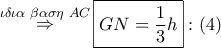
όπου N είναι το σημείο επαφής του έγκυκλου \left( I \right) με την BC. Από MG = \dfrac{1}{3}AM \Rightarrow \left( {BGC} \right) = \dfrac{1}{3}\left( {ABC} \right) \mathop  \Rightarrow \limits^{\iota \delta \iota \alpha \,\,\beta \alpha \sigma \eta \,\,AC} \boxed{GN = \dfrac{1}{3}h}:\left( 4 \right).

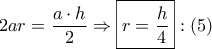
Αλλά \left( {ABC} \right) = \dfrac{{a + b + c}}{2} \cdot r = \dfrac{{a \cdot h}}{2}\mathop  \Rightarrow \limits^{b + c = 3a} 2ar = \dfrac{{a \cdot h}}{2} \Rightarrow \boxed{r = \dfrac{h}{4}}:\left( 5 \right).

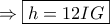
Από \left( 4 \right),\left( 5 \right) προκύπτει ότι I είναι μεταξύ των G,N, άρα από \left( 4 \right) \Rightarrow r + IG = \dfrac{1}{3}h\mathop  \Rightarrow \limits^{\left( 3 \right)} IG = \dfrac{1}{3}h - \dfrac{1}{4}h = \dfrac{h}{{12}} \Rightarrow \boxed{h = 12IG}.
[attachment=0]Υψος υπό συνθήκες.png[/attachment]
\bullet β) Επειδή το
Θ. Κούτρα είναι ισοδυναμία από IG \bot BC θα είναι FQ \cdot AB = KL \cdot AC \Rightarrow

c \cdot \dfrac{{\left| {b - a} \right|}}{{6c}}\left| {3c - b - a} \right| = b \cdot \dfrac{{\left| {c - a} \right|}}{{6b}}\left| {3b - c - a} \right| \Leftrightarrow \left| {b - a} \right| \cdot \left| {3c - b - a} \right| = \left| {c - a} \right| \cdot \left| {3b - c - a} \right| \Leftrightarrow

\left| {3bc - {b^2} - ab - 3ac + ab + {a^2}} \right| = \left| {3bc - {c^2} - ac - 3ab + ac + {a^2}} \right| \Leftrightarrow \left| {3bc - {b^2} - 3ac + {a^2}} \right| = \left| {3bc - {c^2} - 3ab + {a^2}} \right| \Leftrightarrow

\Leftrightarrow 3bc - {b^2} - 3ac + {a^2} = 3bc - {c^2} - 3ab + {a^2}\,\,\, \vee \,\, \,3bc - {b^2} - 3ac + {a^2} =  - 3bc + {c^2} + 3ab - {a^2} \Leftrightarrow

{b^2} - {c^2} - 3a\left( {b - c} \right) = 0\,\,\, \vee \,\, 2{a^2} - 3\left( {b + c} \right)a - {b^2} - {c^2} + 6bc = 0 \Leftrightarrow

\left( {b - c} \right)\left( {b + c - 3a} \right) = 0\,\, \vee \, \,2{a^2} - 3\left( {b + c} \right)a - {b^2} - {c^2} + 6bc = 0 \Leftrightarrow

b = c\,\, \vee \,\,b + c = 3a\,\, \vee \,\, 2{a^2} - 3\left( {b + c} \right)a - {b^2} - {c^2} + 6bc = 0

οπότε η δοσμένη καθετότητα μπορεί να προκύψει τουλάχιστον και στην περίπτωση που b=c


2η Λύση

α) B{G^2} = {\left( {\dfrac{2}{3}{\mu _b}} \right)^2} = \dfrac{4}{9}\mu _b^2 = \dfrac{4}{9}\dfrac{{2{a^2} + 2{c^2} - {b^2}}}{4} = \dfrac{{2{a^2} + 2{c^2} - {b^2}}}{9} και C{G^2} = {\left( {\dfrac{2}{3}{\mu _c}} \right)^2} = \dfrac{4}{9}\mu _c^2 = \dfrac{4}{9}\dfrac{{2{a^2} + 2{b^2} - {c^2}}}{4} = \dfrac{{2{a^2} + 2{b^2} - {c^2}}}{9}

Ετσι B{G^2} - C{G^2} = \dfrac{{2{a^2} + 2{c^2} - {b^2}}}{9} - \dfrac{{2{a^2} + 2{b^2} - {c^2}}}{9} = \dfrac{{{c^2} - {b^2}}}{3}:\left( 1 \right) .

Επίσης I{B^2} = B{N^2} + I{N^2} = {\left( {\dfrac{{a + b + c}}{2} - b} \right)^2} + {r^2} και I{C^2} = C{N^2} + I{N^2} = {\left( {\dfrac{{a + b + c}}{2} - c} \right)^2} + {r^2} οπότε:

I{B^2} - I{C^2} = {\left( {\dfrac{{a + b + c}}{2} - b} \right)^2} - {\left( {\dfrac{{a + b + c}}{2} - c} \right)^2} = {\left( {\dfrac{{a + c - b}}{2}} \right)^2} - {\left( {\dfrac{{a + b - c}}{2}} \right)^2} =

\dfrac{{2a}}{2} \cdot \left( {\dfrac{{2c - 2b}}{2}} \right) = a\left( {c - b} \right)\mathop  = \limits^{b + c = 3a} \dfrac{{b + c}}{3}\left( {c - b} \right) = \dfrac{{{c^2} - {b^2}}}{3}:\left( 2 \right). Από \left( 1 \right),\left( 2 \right) \Rightarrow B{G^2} - C{G^2} = I{B^2} - I{C^2} \Leftrightarrow \boxed{IG \bot BC}.

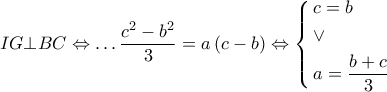
β) Αν IG \bot BC \Leftrightarrow  \ldots \dfrac{{{c^2} - {b^2}}}{3} = a\left( {c - b} \right) \Leftrightarrow \left\{ \begin{gathered} 
  c = b \hfill \\ 
   \vee  \hfill \\ 
  a = \dfrac{{b + c}}{3} \hfill \\  
\end{gathered}  \right. οπότε δεν ισχύει το αντίστροφο.

**Για το ύψος όπως στην πρώτη λύση


Στάθης

Re: Ύψος υπό συνθήκη

Δημοσιεύτηκε: Πέμ Μαρ 16, 2017 2:14 pm
από george visvikis
Σ' ευχαριστώ Στάθη και για τις δύο λύσεις!

Πηγή έμπνευσης της άσκησης είναι το εξαιρετικό άρθρο του Θάνου Μάγκου (4. Οι αποστάσεις OI, GI, HI, Περιοδικό Μελέτη-1, σελίδα 13)

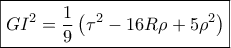
Εκεί δίνεται ο τύπος: \boxed{G{I^2} = \frac{1}{9}\left( {{\tau ^2} - 16R\rho  + 5{\rho ^2}} \right)} (1) (Ομολογώ ότι δεν τον γνώριζα).

Τώρα, από \displaystyle{b + c = 3a \Leftrightarrow } \boxed{\tau  = 2a}, \displaystyle{\tau \rho  = \frac{{ah}}{2} \Leftrightarrow } \boxed{\rho  = \frac{h}{4}} και \displaystyle{bc = 2Rh \Leftrightarrow } \boxed{8R\rho  = bc}

Εξάλλου, \displaystyle{\sqrt {\tau (\tau  - a)(\tau  - b)(\tau  - c)}  = \sqrt {2{a^2}(2a - b)(2a - c)}  = \frac{{ah}}{2} \Leftrightarrow \sqrt {2{a^2}\left[ {4{a^2} - 2(b + c)a + bc} \right]}  = \frac{{ah}}{2} \Leftrightarrow }

\displaystyle{a\sqrt {2bc - 4{a^2}}  = \frac{{ah}}{2} \Leftrightarrow } \boxed{\frac{{{h^2}}}{4} = 2bc - 4{a^2}} (2)

Από την (1) τώρα, έχουμε: \displaystyle{G{I^2} = \frac{1}{9}\left( {4{a^2} - 2bc + \frac{{5{h^2}}}{{16}}} \right)\mathop  = \limits^{(2)} \frac{1}{9}\left( { - \frac{{{h^2}}}{4} + \frac{{5{h^2}}}{{16}}} \right) \Leftrightarrow } \boxed{h=12GI}